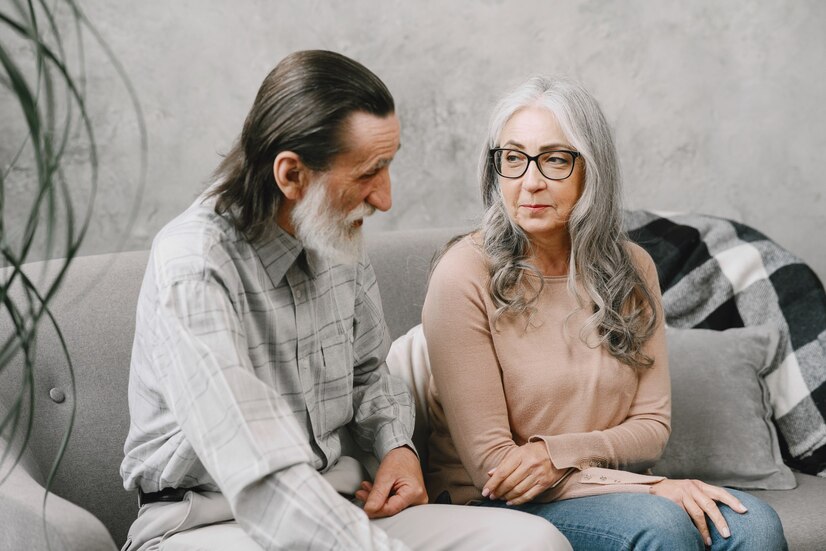
You can be in a relationship and still feel lonely. Most people don’t say that out loud, because it sounds like a contradiction. You have a partner. You share a bed, a calendar, sometimes a mortgage. By every visible measure, you are not alone. And yet you are sitting three feet away from someone you love, watching the same show, and feeling like you’re doing it by yourself.
This is one of the situations I see most often with clients who otherwise describe their relationships as good. Not in crisis. Not heading toward a breakup. Just quiet in a way that has started to feel less like peace and more like distance. Many people interpret that quiet as a sign something is fundamentally wrong. I don’t think that’s usually the case. Feeling lonely in a relationship is not proof that the relationship has failed. It’s often proof that connection requires more than proximity, and that the two of you have drifted into a pattern where you’re physically present but emotionally unreachable to each other.
The people who bring this up in session rarely lead with it. It comes out sideways, after we’ve talked about work stress or family or something that happened last week. “I don’t know how to say this without it sounding dramatic,” they’ll tell me, “but I feel really alone in my marriage.” Then they immediately soften it. Their partner isn’t a bad person. Nothing happened. They just feel far away from someone who is right there.
This post is about that specific gap. Not the loneliness of being single, and not the loneliness of a relationship that’s actively falling apart, but the particular ache of being partnered and still feeling unseen.
Why Feeling Lonely in a Relationship Happens
Loneliness inside a relationship is a documented and fairly common experience, not a sign of an unusual or broken partnership. A validated psychometric scale developed specifically to measure emotional loneliness inside intimate relationships makes the case that marriage and other long-term partnerships are actually the right place to look for this kind of loneliness on its own terms, separate from whether someone is socially isolated. A person can be surrounded by people, married, cohabiting, and still experience real emotional loneliness because this particular relationship isn’t providing the closeness it’s supposed to.
Marital quality research backs this up from a related angle. A longitudinal study on loneliness in marriage found that couples with lower cohesion, meaning less communication and emotional intimacy day to day, consistently reported more loneliness than couples who stayed more emotionally connected. That tracks with what I see clinically across couples of all ages. It’s rarely a single event that creates this kind of loneliness. It’s the slow accumulation of unanswered bids for connection, conversations that stayed on the surface, and small emotional retreats that neither person named at the time.
The U.S. Surgeon General’s 2023 advisory on social connection also matters here, even though it wasn’t written specifically about couples. It reframed connection as a health issue, not just an emotional one, and made the point that the presence of other people in your life doesn’t automatically protect you from the effects of disconnection. The same logic applies inside a relationship. Sharing a home with someone is not the same as being known by them.
What Is Actually Going On Underneath
Here’s what I think most people miss: relationship loneliness is rarely about a lack of love. It’s about a lack of emotional access. You can love someone and still not know how to reach them, or let them reach you. Those are two different skills, and a lot of couples have built a life together without ever really building the second one.
I’ve noticed a specific pattern with the high-achieving clients I work with. They’re excellent at logistics. They coordinate schedules, split responsibilities, remember each other’s parents’ birthdays, plan the trip. What they’ve often never learned is how to sit in a room with their partner and say something true and slightly unfinished, something that doesn’t have a clear point yet. So conversations stay functional. “How was your day” gets answered with a summary, not an actual answer, the same pattern we cover in more depth in Communication Therapist NYC. Over time, both people get fluent in a version of intimacy that looks complete from the outside and feels hollow from the inside.
You know the moment. You’re lying next to your partner at the end of the day, both of you on your phones, and you think about bringing up something that’s actually been on your mind. Then you talk yourself out of it. It feels like too much for a Tuesday. It feels like it would require an explanation you don’t have the energy to give. So you say “I’m fine” instead, and you roll over, and the thing you wanted to say just stays where it was.
I used to think loneliness in a relationship meant the partnership itself was the problem. What changed my mind was watching how often it resolves once a couple relearns how to have an actual conversation, not a status update. The relationship wasn’t broken. The communication pattern was doing exactly what it was built to do, which was keep things smooth and avoid conflict. It just wasn’t built to create closeness.
What the Work Involves
For couples where the loneliness has built up over months or years without either partner naming it, Emotionally Focused Therapy tends to be the most direct route back to each other. It works by slowing down the moments where one partner reaches for connection and the other misses it or pulls back, so both people can see the cycle they’re stuck in instead of just feeling its effects.
For clients who come in individually, often because their partner isn’t ready for couples work yet, Internal Family Systems is useful for understanding the part of them that goes quiet instead of asking for what they need. Most people who feel chronically unseen in a relationship have a well-practiced habit of minimizing their own needs before anyone else can dismiss them. That habit usually didn’t start in this relationship.
Attachment-informed individual therapy also matters here, particularly for people whose instinct under emotional distance is to either chase harder or withdraw completely, a pattern we go into more directly in Fear of Love: Understanding the Anxiety Behind Intimacy. Neither instinct is a character flaw. Both are strategies that made sense at some point, usually earlier than this relationship, and both tend to make the current loneliness worse if they go unexamined.
(If the distance in your relationship shows up more as active conflict or pushing your partner away than as quiet drift, that’s a related but different pattern — see Self-Sabotage in Relationships for that specific dynamic.)
Why New York Makes You Feel Lonely in a Relationship
New York has a particular talent for making two people feel like strangers who happen to live together. Two demanding careers, two commutes, two sets of Slack notifications that don’t stop at six p.m. A lot of couples here are what I’d call logistically excellent and emotionally out of practice. You’ve optimized the calendar so well that you rarely have to sit with each other in unstructured time, which also means you rarely have to be vulnerable with each other in unstructured time.
There’s also the apartment factor. In a six hundred square foot one-bedroom, you are never more than a few feet from your partner, which creates a strange illusion of closeness. Proximity gets mistaken for intimacy. You can be close enough to hear each other breathing and still be having two completely separate emotional experiences of the same evening.
And then there’s the performance layer that comes with a city built around achievement. A lot of the couples I see are good at appearing fine in front of other people, at dinners, at each other’s work events, in the group chats. That performance can start to leak into the relationship itself, where even in private, both partners are managing an image instead of actually being known.
When It Is Time to Get Support for Loneliness in NYC
Most people wait longer than they need to before addressing this, usually because it’s hard to justify. “My relationship isn’t bad enough for therapy” is something I hear constantly. Nobody hit, nobody cheated, nobody said something unforgivable. It just feels quiet in a way that’s started to hurt.
That hesitation makes sense, but it also delays the exact kind of intervention that works best early. Relationship loneliness tends to compound. The longer two people go without real emotional contact, the more each starts to build a private life around the absence — more time alone, more emotional energy spent elsewhere, less instinct to turn toward the other person first. It’s worth getting support before that becomes the norm, not after.
There’s also a specific fear underneath the hesitation for a lot of my clients: that naming the loneliness out loud will make it more real, or will hurt their partner in a way they can’t take back. In practice, the opposite is usually true. Partners are frequently relieved to hear it named, because they’ve often been feeling some version of the same distance and didn’t know how to bring it up either.
The Person Who Does Not Fit the Standard Narrative
The client I think about most in this category isn’t the one whose relationship looks obviously strained. It’s the one whose relationship looks, from every outside angle, like it’s working. Good communication about the practical stuff. No major conflict. A partner who is kind, present for the big things, reliable. This client will often preface the whole conversation with, “I feel guilty even bringing this up, because he’s a genuinely good partner.”
That guilt is worth naming directly, because it keeps a lot of people from getting help. You do not need a bad relationship to justify feeling lonely in it. A kind, reliable, well-intentioned partner can still be someone you’ve stopped being emotionally honest with, and someone who has stopped being emotionally honest with you. Loneliness doesn’t require a villain. It usually just requires two people who got busy, got tired, and quietly agreed, without ever saying so, to stop reaching for each other the way they used to.
What to Expect
The first session is usually less about assigning blame and more about mapping the specific pattern that’s created the distance. I’ll ask about a recent moment that felt lonely, not in the abstract, but the actual scene: what was said, what wasn’t said, what you wanted to happen instead. That specificity is where the real information lives.
If you’re coming in individually, we’ll also spend time on your own history with closeness, because the way you respond to emotional distance now was usually shaped well before this relationship. If you’re coming in as a couple, early sessions focus on slowing down your particular cycle enough that you can both see it happening in real time, rather than just living inside it.
How It Works at Uncover Mental Health Counseling
Sessions happen over telehealth, available anywhere in New York State, which tends to work well for the two-career, over-scheduled couples and individuals I see most. There’s no insurance billing involved, which means no diagnosis requirement and no limit on session frequency or approach. It starts with a free consultation to talk through what’s going on and whether working together makes sense, followed by weekly sessions from there.
FAQ
Is it normal to feel lonely in a relationship even when things are generally good? Yes. Emotional loneliness inside an otherwise stable relationship is one of the more common reasons people start therapy, and it’s not a sign the relationship is doomed. It’s usually a sign that emotional closeness has quietly slipped down the priority list.
What’s the difference between loneliness in a relationship and just needing space? Needing space is about wanting time alone. Relationship loneliness is about feeling emotionally unreached even when you’re together. You can want both closeness and space at different moments, but the loneliness this post is about persists even during the time you do spend together.
Should we try couples therapy or should I go alone first? Either can work. Couples therapy is often the more direct route if both partners are willing. Individual therapy is a reasonable place to start if your partner isn’t ready yet, and it can still shift the dynamic significantly.
Can this be fixed if we’ve been distant for years, not months? Duration matters less than most people expect. What matters more is whether both people are willing to look at the pattern honestly. I’ve worked with couples who’d been distant for a decade and rebuilt real closeness, and couples who caught it after a few months and still struggled, because willingness mattered more than timeline.
Does feeling lonely in my relationship mean I don’t love my partner? No. Love and emotional access are related but separate things. You can love someone deeply and still have lost the skill, or the practice, of actually reaching them.
Ready to Stop Feeling Lonely in a Relationship?
You started this piece because something about “together but still alone” landed. That’s usually enough of a reason to look closer. The shift, when it happens, is rarely dramatic. It looks like an ordinary Tuesday conversation that goes one layer deeper than it used to.
Uncover Mental Health Counseling offers virtual couples and relationship therapy across New York State for individuals and couples working through exactly this. Book a free consultation to talk about what’s going on.
Kristie Tse, LMHC-D is the founder of Uncover Mental Health Counseling (NY License #009672), a virtual private pay practice serving high-achieving adults across New York State. She specializes in relationships, anxiety, self-esteem, and identity with high-achieving adults, and has a particular focus on Asian American adults, LGBTQ+ individuals, and first-generation Americans. Her work has been featured in HuffPost, Verywell Mind, Well+Good, and Bustle.